This story is a joint effort between Rachel Hostetler, Goshen College Music Together teacher, and Leah Plank, director of Triple P Elkhart County.
Highlighting an impactful partnership
During the last year and a half, Goshen College Music Together and Triple P Elkhart County have launched a unique partnership fostering early relational health among Elkhart County children 0-3 years old and their caregivers. This project is made possible by an Early Years Initiative Grant from Early Learning Indiana, a program of the Lilly Endowment. Mrs. Rachel, a Music Together teacher, shares a highlight from her current preschool class in Elkhart that offers multiple examples of early relational health emerging naturally with the support of Music Together.
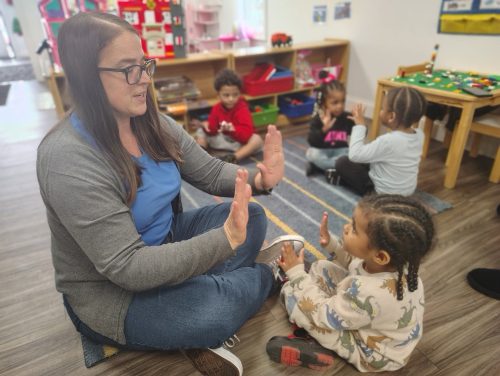 “I am having a great experience with the 3 year old class at Small Miracles daycare. They keep surprising me. I had only planned to use the songbooks with them one time before sending them home but they did such a good job that we used them in class for six weeks! The kids were very good about helping each other find the right page and even nudging their friends if they were not pointing to the right pictures when singing. The teacher, Ms Jackie, was also a little surprised, I think, to see how carefully they were able to handle the books, and also, how they were able to follow this kind of guided music activity. I can tell she is proud of them when they follow along and work together. I also think it’s a good chance for her to see that all the work she is doing with her kids is paying off. I hope that music class gives her a chance to observe them and enjoy them in a way you can’t always do when you are leading. In music class, she can participate alongside them and enjoy them.
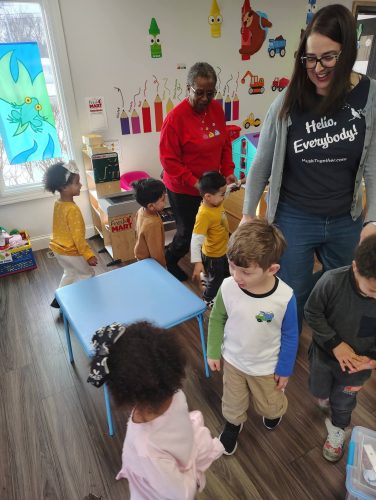
On my first visit to the Small Miracles baby class, they had all the babies in their seats at the group feeding table. I asked them to get the babies out so that we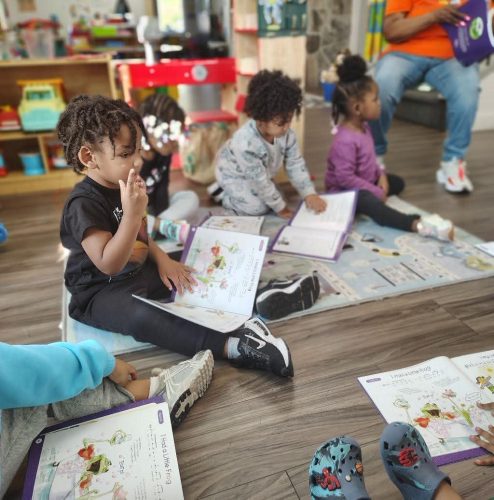 could sit on the floor in a circle. They were surprised and told me they had put them there because they thought it would be easier for me if they were all in their spots. I explained that we want them to be able to move their bodies freely and that we will also be moving around together carrying the babies. Ever since, we have had a great time sitting on the floor, each adult with at least one, usually two, babies on their lap. The teachers now know the songs and are singing along with me, and the babies are beginning to vocalize a lot. One of the younger babies was vocalizing all through our final song last week. After class, I was getting my shoes on in the lobby, and the sounds I heard coming from the room were beautiful – it sounded like a baby choir. There was such a wide range of vocalization happening from many different babies. It was like the language switch in their brains got turned on from all our singing. I also heard the voices of the teachers chatting with each other and the babies, calm and relaxed. I think all the ‘happy chemicals’ that are released when singing help the teachers to make it through the rest of their day too.”
Indicators of early relational health
 Early relational health is grounded in warm, responsive, and attuned interactions between children and the adults who care for them. The experiences described in Mrs. Rachel’s story highlights several core ERH elements
- Warm, attuned adult-child interactions: In both classrooms, adults are fully present with children, singing, making eye contact, helping them find pages, and responding to their vocalizations. These moments of shared attention and joy strengthen the relational bond and support healthy brain development.
- Co‑regulation and emotional safety: Sitting together on the floor, holding babies on their laps, and singing as a group creates a calm, predictable environment. The babies’ increasing vocalizations show that they feel safe enough to explore their voices and engage socially.
- Shared joy and positive emotional climate: The “baby choir” moment is a powerful example of collective joy. The teachers’ relaxed voices and the babies’ wide range of sounds reflect a classroom climate where positive emotions are contagious and reinforcing.
- Strengthening caregiver confidence and connection: The preschool teacher’s pride in her students’ ability to follow along and work together reinforces her sense of competence and connection with the children. Music class gives her a rare opportunity to observe and enjoy her students without the pressure of leading, deepening her relationship with them.
- Modeling responsive caregiving: By encouraging teachers to bring babies to the floor and engage physically and emotionally with them, Music Together is modeling developmentally supportive practices. Teachers quickly adopt these behaviors, singing along, holding babies, responding to cues, which strengthens their ongoing relationships with the children.
- Building relational capacity across the caregiving system: As teachers participate alongside children, they experience the benefits of shared positive interactions themselves. This not only supports the children but also enhances teacher well‑being, which is a key component of a healthy relational environment.
On behalf of Goshen College Music Together, we are so grateful for Triple P Elkhart County’s leadership and support in this project!